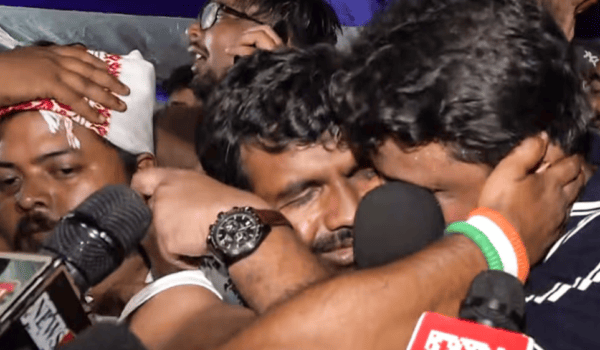
CPM leader Pinarayi Vijayan on Wednesday strongly condemned the detention of Leader of the Opposition Rahul Gandhi and several opposition leaders during a protest in New Delhi over alleged irregularities in the NEET examination. Meanwhile, BJP Kerala president Rajeev Chandrasekhar defended the Delhi Police’s actions, saying democracy allows peaceful protests but not violence or lawlessness.
The political reactions came a day after Rahul Gandhi, Congress general secretary Priyanka Gandhi Vadra, Samajwadi Party chief Akhilesh Yadav, and several opposition MPs were detained by Delhi Police after staging a surprise dharna near Prime Minister Narendra Modi’s residence. The leaders were demanding the Prime Minister’s resignation over the alleged NEET examination irregularities and the police action against protesting students.
Gold 101.3FM – UAE’s No. 1 Radio Station brings you the latest updates from India and around the world.
In a Facebook post, Pinarayi Vijayan alleged that the Centre was attempting to suppress the growing nationwide protests over the NEET controversy. He said the agitation had gained momentum over the past several weeks, with Left student organisations supporting the movement from the beginning, followed by several opposition parties and Members of Parliament.
Pinarayi also claimed that CPM general secretary M.A. Baby, along with other party leaders and MPs, formed a protective shield around protesters to prevent what he described as excessive police action. He further alleged that individuals carrying lathis had joined police personnel in attacking demonstrators, accusing the Centre of trying to silence dissent. According to him, such actions were only increasing public support for the movement.
Expressing solidarity with Rahul Gandhi, Pinarayi said he strongly condemned the Congress leader’s detention and reaffirmed support for those protesting over the alleged examination irregularities.
Kerala’s Leader of the Opposition V.D. Satheesan, who participated in the protest march alongside Karnataka Chief Minister D.K. Shivakumar and MPs from Kerala, also criticised the Delhi Police action, calling it “anti-democratic.”
In a Facebook post, Satheesan alleged that Rahul Gandhi was dragged along the road by Delhi Police personnel and claimed that Priyanka Gandhi Vadra was restrained by male police officers. He said the only “offence” committed by opposition leaders was standing in solidarity with students demanding accountability.
Satheesan further alleged that students had “bled on the streets of Delhi” and described the police action as a continuation of what he termed “fascist tendencies.” He accused the Centre of attempting to intimidate those raising their voices but asserted that the Congress would continue supporting the students’ cause.
“Rahul Gandhi and those standing with him are voicing the sentiments of the country. If the government believes it can suppress that voice, it is mistaken,” Satheesan said.
Responding to the criticism, BJP Kerala president Rajeev Chandrasekhar defended the police action while reiterating that peaceful protests are protected under democracy.
“Protests are a part of democracy and are the right of every citizen. Agreed,” Chandrasekhar said in a post on X. “Violent protests are not democracy. Anarchy is not democracy. Lawlessness is not democracy,” he added.
Emphasising the importance of maintaining public order, Chandrasekhar said every citizen expects that the law holds those who break it accountable and that the rule of law must prevail over anarchy.
The controversy stems from Tuesday’s protest outside the Prime Minister’s residence, where Rahul Gandhi and several opposition leaders demanded a discussion on the alleged NEET examination irregularities, action against those responsible for the police crackdown on students, and the resignations of Union Education Minister Dharmendra Pradhan and Union Home Minister Amit Shah.
Following the demonstration, Delhi Police detained Rahul Gandhi, Priyanka Gandhi Vadra, Akhilesh Yadav, and several opposition MPs before taking them to different police facilities across the capital. All of them were later released.