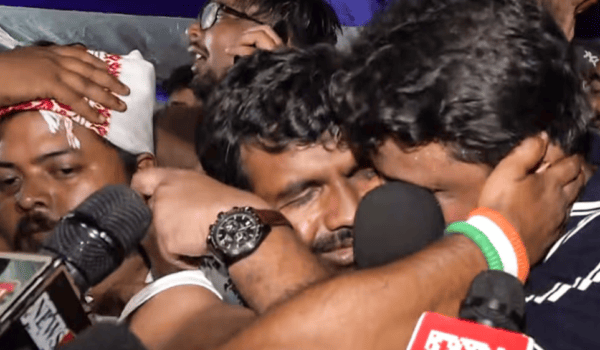
More than two decades after the Muthanga agitation shook Kerala, the District Principal Sessions Court on Friday delivered its verdict in one of the state’s most closely watched cases. The court acquitted all the accused in the alleged murder of police constable K.V. Vinod, ruling that the prosecution had failed to establish the murder charge beyond reasonable doubt.
Delivering the judgment, District Principal Sessions Judge Ayoob Khan also held that the prosecution was unable to prove the conspiracy charges levelled against the 35 accused in the case.
Gold 101.3FM UAE’s No. 1 radio station continues to bring listeners the latest updates from India and around the world, covering major legal developments, public affairs, and stories that have shaped history.
While acquitting the accused in the murder case, the court found four persons—Binu, Sundaran, Geethanandan, and Rameshan—guilty of attempting to murder police officer Abdul Salam during the violence. The four were sentenced to five years of rigorous imprisonment.
The court observed that tribal leader Asokan, who was the second accused in the murder case, had inflicted the fatal injury on constable Vinod. However, Asokan passed away several years ago, and the proceedings against him had already abated.
The case was investigated by the Central Bureau of Investigation (CBI) following widespread controversy surrounding the police action. The incident dates back to February 19, 2003, when violent clashes broke out during an eviction drive at Thakarappady in the Muthanga Forest Range of the Wayanad Wildlife Sanctuary. Landless tribal families, under the banner of the Adivasi Gothra Maha Sabha (AGMS), had occupied forest land, claiming traditional rights over it.
The confrontation turned violent, resulting in the deaths of police constable K.V. Vinod and tribal activist Jogi. Hundreds of tribal protesters and several police personnel were also injured during the clashes.
The Muthanga incident drew national and international attention, with political leaders, writers, and human rights activists alleging that the then government had used excessive force while carrying out the eviction. Allegations of atrocities against tribal women and children further intensified public criticism and prompted demands for an independent investigation.
According to the prosecution, violence escalated after tribal families refused to vacate the occupied land. During the eviction operation, constable Vinod was allegedly taken hostage by protesters at Gowdanvayal near Thakarappady. Police subsequently resorted to firing plastic and rubber bullets in an attempt to disperse the crowd and rescue the constable. The operation ultimately ended with the deaths of Vinod and Jogi.
In the wake of the controversy, the then United Democratic Front (UDF) government led by A.K. Antony transferred the investigation to the CBI.
During the final phase of the trial, the prosecution completed its arguments before the defence presented detailed submissions over four days. The court also permitted CBI Special Public Prosecutor Advocate Boby Joseph to present rebuttal arguments addressing the defence’s claims before concluding the hearings.
Appearing for the accused, Advocate T.M. Rasheed challenged the prosecution’s version of events, arguing that both Vinod and Jogi died inside the same temporary shed at Gowdanvayal during the eviction operation and around the same time. He contended that the prosecution had failed to conclusively establish the exact sequence of events, the circumstances of the deaths, or the identity of those responsible.
The defence also questioned the reliability of witness testimonies and highlighted alleged inconsistencies in the prosecution’s case. The CBI, however, maintained that the evidence presented during the trial clearly established the involvement of the accused in the offences charged.
With Friday’s verdict, the court has brought to a close one of Kerala’s longest-running criminal trials arising from the 2003 Muthanga agitation, a case that remained at the centre of legal, political, and human rights discussions for more than two decades.